What if Everyone Sees the Risk?
It’s a question we’ve heard throughout the year: If everyone sees the risks, why hasn’t the market fallen more?
It’s a fair question. We tend to think markets react to risks the moment they become obvious. In reality, markets don’t move simply because risks exist - they move when reality turns out differently than investors expected.
That’s an important distinction.
Today’s concerns aren’t hidden. Investors know inflation remains elevated. They know interest rates could stay higher for longer. They know geopolitical conflicts, policy uncertainty, and slowing economic growth all have the potential to affect markets. Those risks have been discussed by investors, economists, businesses, and the financial media for months.
Because they’re widely recognized, markets have already spent considerable time incorporating them into prices. One of the biggest misconceptions in investing is that markets simply reflect today’s headlines. Markets spend far more time evaluating tomorrow’s possibilities, and prices adjust as investors collectively reassess what the future may look like, not simply because today’s news is “good” or “bad.”
That doesn’t mean those risks have disappeared, and it doesn’t mean volatility can’t increase. It means that the existence of a risk alone isn’t always enough to move markets. What matters is whether future developments are better or worse than what’s already expected.
This is one of the reasons successful investing is rarely about identifying the risk that everyone else has missed. More often, it’s about recognizing that there are many possible outcomes - and building a portfolio that can weather all of them.
Consider today’s environment. If inflation cools more quickly than expected, one set of investments may benefit. If interest rates remain elevated, another may prove more resilient. If economic growth surprises to the upside, market leaders could shift again. The future rarely unfolds according to a single forecast.
Rather than building portfolios around one prediction, we build them to remain resilient across many possible outcomes.
That means we don’t assume inflation will follow one path, interest rates will move in one direction, or geopolitical tensions will resolve on any particular timeline. Instead, we focus on diversification, thoughtful asset allocation, and maintaining a long-term perspective.
Markets will always have something to worry about. New risks will emerge, and others will fade into the background. While the headlines change, the discipline required for successful investing does not. It’s also worth remembering that the market and the economy are not the same thing. The economy reflects activity happening today – employment, spending, wages, and production. Markets, on the other hand, are constantly forward-looking, incorporating expectations about corporate earnings, interest rates, and future growth. While the two are certainly related, they don’t always move in lockstep.
The goal isn’t to predict every twist and turn; it’s to own a portfolio that can adapt as the future unfolds, because uncertainty isn’t an obstacle to investing - it’s a permanent feature of it.
Stock Market Drawdowns Since 1928
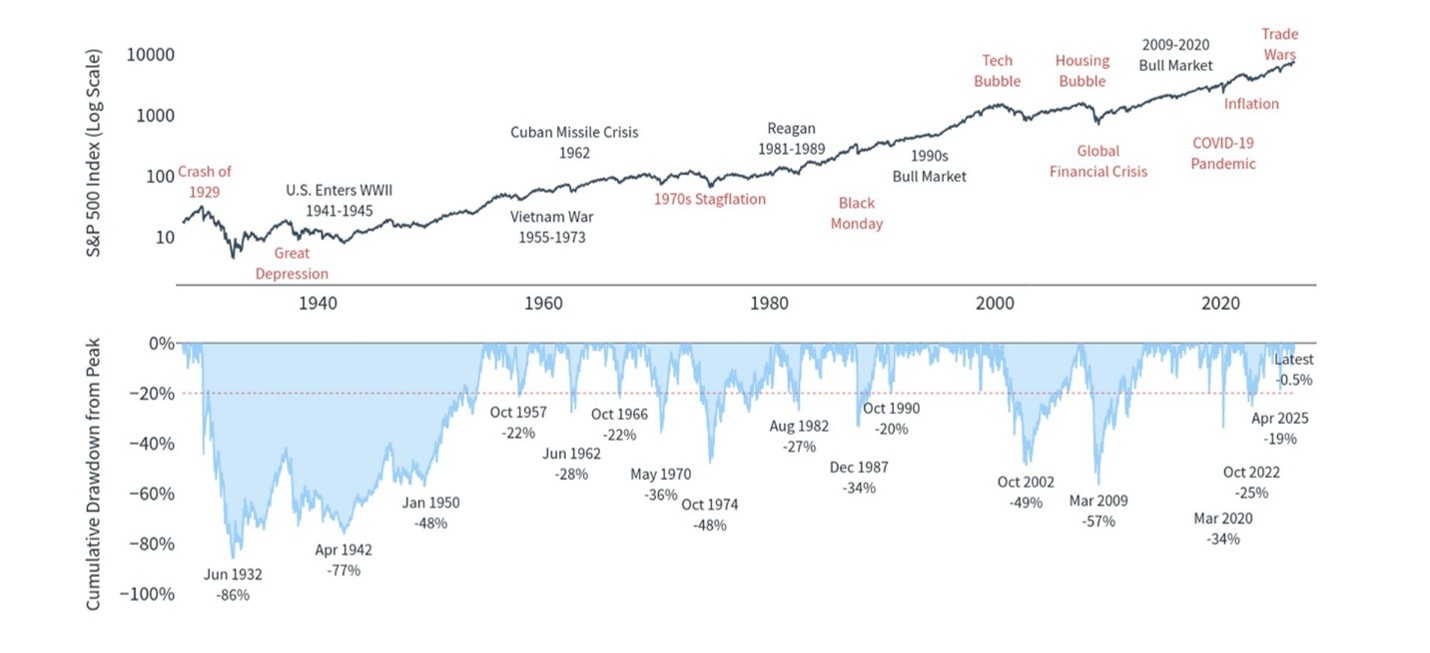
Every market decline feels different in the moment. The headlines change, the causes vary, and the uncertainty can feel overwhelming. Yet history shows a consistent pattern: markets have endured wars, recessions, inflation shocks, political turmoil, and financial crises - and continued to move higher over time. While volatility is an inevitable part of investing, it has historically been the price paid for long-term growth.